Readers keep running into the same wall: a favourite age-stated bottle disappears from shelves, a distillery says a release is “on hold,” and the explanation offered is usually just “there’s a shortage.” That’s true, but it’s not an answer — it’s a symptom of a supply chain decision made more than 30 years ago. This guide is about that decision and what followed it. For how the shortage translates into what you actually pay at the register versus at auction, see our companion piece on why Japanese whisky is so expensive; this one stays on the industrial history.
The 1983 peak, and the crash that followed
Japan’s whisky market hit its high-water mark in 1983, when tax-paid shipment volume reached 381,000 kilolitres, according to National Tax Agency data reported by the Japanese trade publication WANDS (Japanese). From there it fell almost every year for over two decades, bottoming out at roughly 75,000 kilolitres in 2007 — about a fifth of the 1983 figure. That collapse happened while a generation of drinkers moved to shochu, low-malt “happoshu” beer, and chuhai canned cocktails, and while a 1989 change to Japan’s old liquor-grading system pushed up prices on whisky that had previously been cheap.
What producers did in response
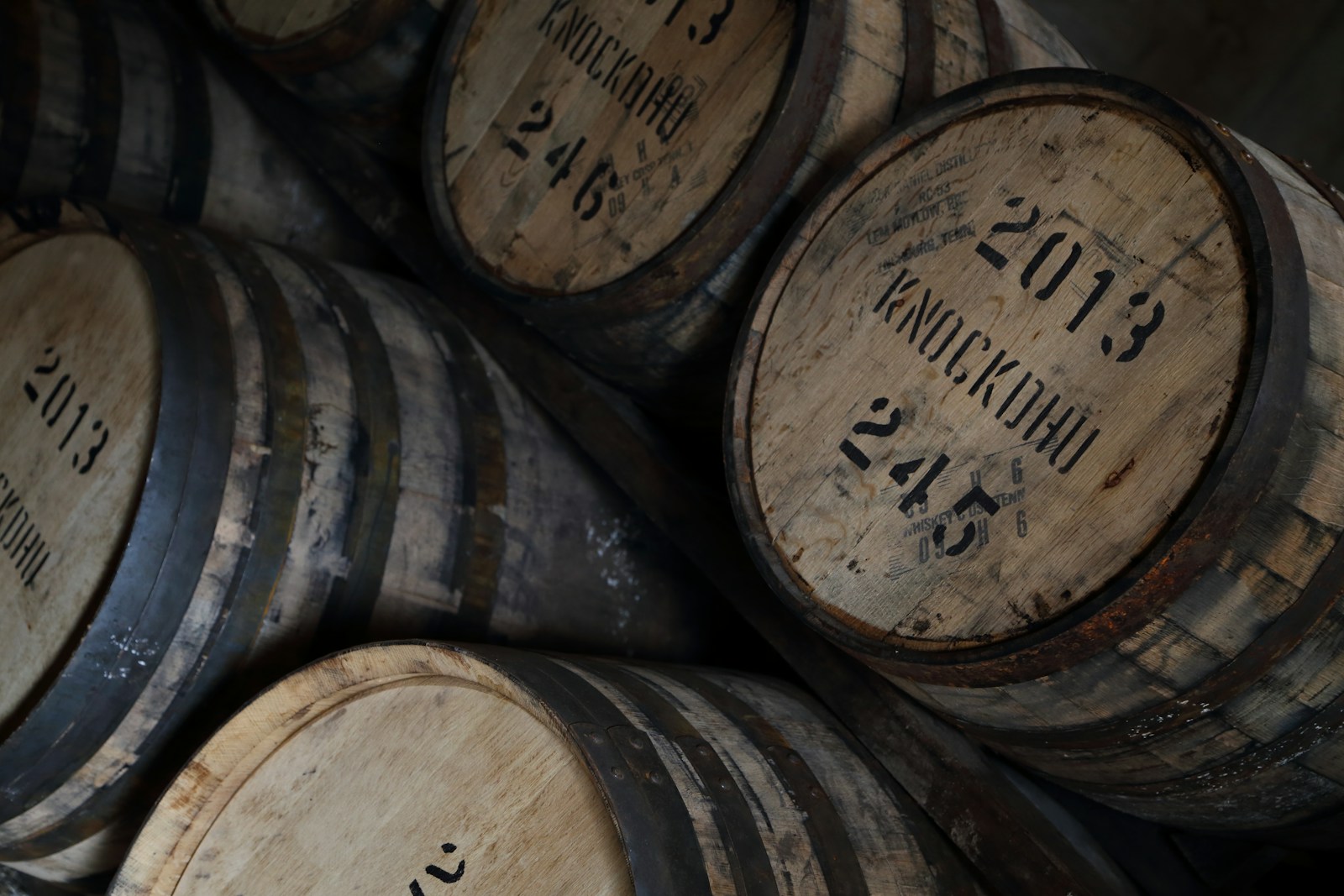
Facing a shrinking market, distillers did the only thing that made financial sense at the time: they cut production, mothballed equipment, and in some cases closed distilleries outright rather than keep filling casks nobody was buying. Karuizawa distillery is the best-documented case — production wound down around 2000 and the site was fully shut within the following decade, according to WHISKY Magazine Japan’s own account of visiting the plant (Japanese). Multiplied across the industry, this is the root of today’s shortage: the whisky that would be a mature 20-year-old today mostly was never laid down in the first place, because nobody in the 1990s could justify tying up capital in casks for a market that was shrinking every year.
Whisky cannot be manufactured on demand
This is the part most explanations skip past. A distillery can build a new still, hire more staff, and start filling casks within a year or two once demand returns. What it cannot do is make those casks 15 years old any faster. A bottle released in 2026 carrying a 15-year age statement has to contain spirit distilled in 2011 — and 2011 was still deep in the trough, when nobody was filling casks at scale.
The gap nobody could fill retroactively
By the time global demand turned around, the industry was sitting on a hole in its inventory shaped exactly like “everything distilled between roughly 1990 and 2010.” No amount of investment made after that point could put whisky into that gap, because whisky only comes from casks filled in the past, not the present. That is why supply has stayed tight for so long after demand recovered — the fix had to be planted years before anyone knew it was needed.
This is also why the shortage hits some age brackets much harder than others. A distillery can accelerate how much three-year-old whisky it has by simply filling more casks and waiting three years. It cannot do the equivalent for an 18-year-old expression without first surviving 18 years of consistent cask-filling, which is precisely the stretch the industry mostly skipped. That mismatch is why you can now find plenty of young, interesting Japanese whisky at reasonable prices while the specific 15-, 18- and 21-year-old bottlings that used to anchor the big brands’ core ranges remain the hardest category to find at all.
Laid out as a timeline, the shortage looks less like a single event and more like four decisions, each made under different pressure, that compound on each other:
| Period | What happened to demand | What producers did | Effect on today’s supply |
|---|---|---|---|
| 1983–2007 | Fell almost every year, to about a fifth of the 1983 peak | Cut production sharply; some distilleries mothballed or closed | The 15–25 year age brackets are the scarcest today |
| 2008–2013 | Domestic demand recovers, driven by the highball | More casks filled, but for younger blended whisky | More young stock exists, but it is not old enough to be “aged” yet |
| 2014–2019 | Global demand surges after international award wins | Age statements pulled to stretch thin reserves further | No-age-statement blends become the default on core shelves |
| 2016–2026 | Demand stays strong in Japan and overseas | Well over 100 new distilleries founded, building or planned | Young whisky supply improves; aged supply is still years from catching up |
The demand nobody predicted
Ironically, distillers spent the 2000s planning for continued decline just as two separate waves of demand were about to hit at once.
The highball brought Japan back first
Suntory launched its “Kaku Highball” campaign nationwide in September 2008, pushing bars and restaurants to serve its Kakubin whisky mixed with soda over ice, according to a report at the time in the Japanese trade paper Nissyoku Shimbun (Japanese). It worked: 2009 was the first year of growth in domestic whisky demand in 11 years, and 2010 marked the first back-to-back annual increase in 27 years. That revival rebuilt a domestic market for whisky, but it also meant more current-generation stock was being drawn down for highballs rather than set aside to age.
Then the world discovered it
The bigger shock came from outside Japan. In November 2014, Suntory’s Yamazaki Single Malt Sherry Cask 2013 was named World Whisky of the Year in Jim Murray’s Whisky Bible 2015 — the first time a Japanese whisky had topped that list — a result Suntory announced on its own corporate site. International demand for Japanese whisky accelerated sharply after that, arriving at the exact moment the industry had the least mature stock in decades to meet it with.
Age statements were the first thing to give
Faced with rising demand and a hole in aged inventory, Suntory and Nikka spent the mid-to-late 2010s quietly withdrawing age-stated expressions from their core ranges and replacing them with no-age-statement blends that could be built from whatever stock was actually available, rather than a fixed number of years. It’s a supply decision, not a quality one, and it is really a pricing story as much as a shortage story — we’ve broken down exactly how that shift affects what you pay in our companion article on Japanese whisky pricing, so we won’t repeat it here. What matters for this piece is simpler: pulling an age statement doesn’t create more aged whisky, it just stops advertising how little of it there is.
The correction that is now underway
The response to the shortage has been to build. Some of the new distillers are established sake and shochu brewers who added a whisky operation, and some are entirely new companies; Chichibu, founded in Saitama in 2008, is generally credited as the distillery that kicked off the current wave, followed roughly a decade later by newer names such as Kanosuke in Kagoshima. You can browse the full current roster in our list of Japanese whisky distilleries by region.
A more-than-tenfold increase in distilleries
The scale of that building boom is now documented in hard numbers. The Whisky Culture Research Institute’s Japanese Whisky Yearbook 2026, announced in a February 2026 press release (Japanese), lists 126 distilleries across Japan when operating, under-construction and planning-stage sites are all counted together — a figure the publisher describes as having “more than tenfold” the number of distilleries recorded less than a decade earlier, and the highest count on record.
Why this won’t show up on shelves immediately
Here is the catch that makes this a slow correction rather than a fast one: almost none of that new capacity has whisky old enough to bottle as an age-stated release yet. A distillery that opened in 2017 could, at the earliest, release a genuine 10-year-old in 2027. Most of what these newer distilleries are selling right now is young — three to eight years old — which adds welcome variety and competition to the market, but does not directly replace the specific 15- and 18-year-old bottlings that vanished from Suntory’s and Nikka’s core ranges. Relief for those specific age brackets is still years away, not months.
It also matters who is doing the building. A number of the newer names are established sake or shochu breweries that already had licensed distilling infrastructure and simply added whisky production alongside their existing business, which let them start filling casks faster than a completely new company could. Others are backed by trading houses or private investors betting specifically that global demand for Japanese whisky will still be strong once their stock finally reaches a sellable age. Either way, the decision to fill a cask today is still a bet on demand more than a decade from now, which is exactly the kind of bet the industry got badly wrong in the 1990s.
Is the shortage actually ending?
Partially, and unevenly. Entry-level and younger-aged whisky is easier to find today than it was five years ago, simply because there are far more producers making it. What remains genuinely scarce is anything that needed 15 to 25 years of continuous, unbroken cask-filling discipline to exist — and that discipline only restarted industry-wide sometime after 2008. On that math, the deepest part of the shortage, for the oldest expressions, does not fully resolve until sometime in the mid-2030s at the earliest, even if every distillery currently operating keeps filling casks at full capacity every single year between now and then.
Q: Why can’t distilleries just make more whisky to fix the shortage?
A: They can, and many are, but new production only fixes the shortage of young whisky immediately. Whisky that needs to carry a 15- or 18-year age statement has to be distilled 15 or 18 years before release, so casks filled today cannot help a shortage of already-aged stock; they can only prevent the same gap from recurring a decade and a half from now.
Q: When did the Japanese whisky shortage actually start?
A: The shortage traces back to underinvestment during the long domestic sales decline that followed the 1983 peak in tax-paid shipments, which did not bottom out until around 2007. Casks that should have been filled during roughly 1990 to 2010, to be ready as today’s aged releases, mostly were not, because the market looked like it was permanently shrinking at the time.
Q: Are new craft distilleries solving the problem?
A: They are solving the long-term version of the problem by filling casks again at a scale the industry had not seen in decades, with well over 100 distilleries now operating, built or planned according to industry trackers. They are not solving the short-term problem, because whisky from a distillery that opened in the late 2010s or 2020s is still too young to replace a discontinued 15- or 18-year-old release.
Q: Is the shortage the same thing as the reason Japanese whisky is so expensive?
A: They’re related but not identical. The shortage is a supply-side, historical problem: not enough aged cask stock exists because not enough casks were filled decades ago. The price you pay today also reflects separate factors layered on top of that scarcity, including current production costs, currency movements, import duty and, at the extreme end, auction speculation on rare bottles that will never be made again.
Sources:
- WANDS, whisky market overview citing National Tax Agency tax-paid shipment data (Japanese) — wandsmagazine.jp
- Nissyoku Shimbun, report on Suntory’s 2008 Kaku Highball campaign launch (Japanese) — news.nissyoku.co.jp
- WHISKY Magazine Japan, account of Karuizawa distillery’s closure (Japanese) — whiskymag.jp
- PR TIMES, Whisky Culture Research Institute press release on the Japanese Whisky Yearbook 2026 (Japanese) — prtimes.jp
- Suntory, official announcement of the Yamazaki Single Malt Sherry Cask 2013 World Whisky of the Year award — suntory.com