Japanese whisky and bourbon end up on the same back bar, but they are built by two completely different rulebooks. Bourbon answers to a US federal regulation with specific numbers attached: a minimum corn percentage, a maximum distillation proof, a barrel that has to be new. Japanese whisky answers to a voluntary industry standard published in 2021 that reads more like a definition than a recipe. Neither is stricter than the other across the board — they simply regulate different things. This piece works through what each system actually requires, where the two philosophies genuinely diverge on grain and casks, and why one of America’s laws is quietly responsible for a large share of the barrels sitting in Japanese warehouses today.
Two different legal traditions, one shared word
“Whisky” covers a wide family of spirits, and the word alone tells you almost nothing about how strict the rules behind it are. Bourbon is defined by the US Alcohol and Tobacco Tax and Trade Bureau (TTB) under federal regulation, binding on every producer that wants to use the name. Japanese whisky, by contrast, is defined by the Japan Spirits & Liqueurs Makers Association (JSLMA, 日本洋酒酒造組合), a trade body whose standard is voluntary and enforceable only against its own members. We covered how that standard came about, and why it exists at all, in our explainer on what actually counts as Japanese whisky. That piece and our separate comparison of Japanese whisky versus Scotch both focus on regulatory history and geographic labelling law. This one is about something narrower and more concrete: what bourbon’s law specifies about grain and wood, and how differently the Japanese standard treats the same two questions.
What US federal law actually requires of bourbon
Bourbon’s legal definition sits in 27 CFR 5.143, the TTB’s standards of identity for distilled spirits, and it is unusually specific compared to most whisky categories worldwide. To be labeled bourbon, a spirit has to be distilled in the United States from a fermented mash of at least 51% corn, with the rest typically made up of rye, wheat, and malted barley. It cannot be distilled above 160 proof (80% ABV), and once distilled it has to go into the barrel at no more than 125 proof (62.5% ABV). The barrel itself is the strictest part of the rule: it must be new, charred, oak, and used only once for that batch of bourbon. There is no minimum aging period to be called bourbon at all — a spirit that meets the mash, proof, and barrel rules is legally bourbon the moment it touches wood. “Straight bourbon” is the version most drinkers actually picture, and it does carry a minimum: at least two years in that new charred oak barrel. Whiskies aged under four years, straight or not, are required to carry an age statement on the label; anything four years or older can leave it off.
What the JSLMA standard actually requires of Japanese whisky
Japan’s standard covers similar ground — ingredients, place of production, aging, bottling strength — but sets the bar differently at almost every point. Malted grain has to be part of the mash, but unlike the popular claim you will see repeated across whisky blogs, Japanese whisky is not required to be made entirely from malted barley; other cereals such as corn or rice can be added alongside it, the same way bourbon adds rye or wheat around its corn base. What the JSLMA standard does insist on is geography: the water has to be sourced in Japan, and mashing, fermentation, and distillation all have to happen at a licensed Japanese distillery, with the spirit coming off the still at under 95% ABV. Aging has a real floor here that bourbon does not have — a minimum of three years, in wooden casks no larger than 700 liters, stored inside Japan — and the finished product has to be bottled in Japan at a minimum of 40% ABV. Oak is typical for the cask but, notably, not required by the wording of the standard itself.
Grain to glass: why the mash bill shapes how each spirit gets used
Corn ferments into a sweeter, heavier new-make spirit than malted barley does, and that difference survives distillation and aging in a way that shapes how each category tends to be drunk. Bourbon’s corn-forward mash produces the vanilla, caramel, and baking-spice character most drinkers associate with the category before oak is even part of the conversation, and a lot of that character holds up well over ice or in a Manhattan. Japanese whisky’s malt-and-grain approach, closer to the Scotch model that Masataka Taketsuru studied before founding Nikka, tends toward a lighter, drier base spirit, which is one reason the country’s blended whiskies work so well diluted heavily with soda rather than served with just a splash of water — the subject of our separate guide to building a proper Japanese highball. Neither approach is better; they are simply optimized for different glasses.
The cask question: new wood versus reused wood
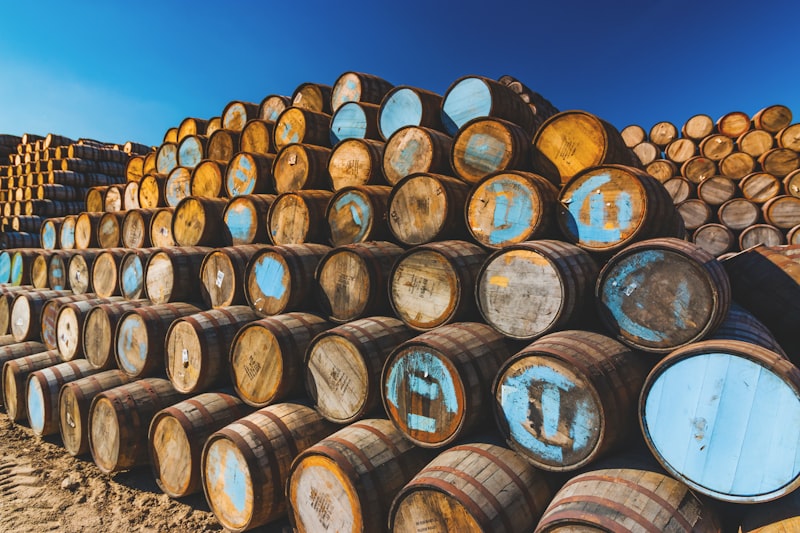
This is where the two systems diverge the most, and where the connection between them is easy to miss. Because US law requires bourbon to age in a new charred oak barrel every single time, American distillers cannot legally reuse their own barrels for a second batch of bourbon. That rule, which traces back to Prohibition-era regulation finalized under the Federal Alcohol Administration Act, created a byproduct nobody was necessarily planning for: a huge, continuous supply of once-used oak barrels with nowhere else to go inside the US bourbon industry. Scotch producers absorbed a large share of that supply decades ago, and Japanese distillers followed the same path. Ex-bourbon casks are relatively cheap, plentiful, and give a cleaner, more approachable barrel character than a first-fill would, which made them a practical foundation for Japanese single malt and blended whisky production. The JSLMA standard’s silence on new-versus-used wood is not an oversight; it reflects an industry that was built, in large part, on casks bourbon distillers were legally required to give up after one use. Japanese distillers also lean on Japanese oak, or mizunara, for some releases — a wood that entered the picture as a wartime substitute rather than a deliberate stylistic choice, covered in more detail in our piece on mizunara oak and how it ended up in Japanese whisky.
Side by side: the rules that actually differ
| Rule | Bourbon (27 CFR, US federal law) | Japanese whisky (JSLMA standard) |
|---|---|---|
| Grain | At least 51% corn in the mash | Malted grain always required; other cereals like corn or rice may be added |
| Cask | New, charred oak only, one use only | Wooden cask, 700 liters or smaller; oak typical but not mandated; reuse is standard practice |
| Minimum aging | None for “bourbon”; 2 years for “straight bourbon” | 3 years, aged inside Japan |
| Bottling strength | Minimum 40% ABV (80 proof) | Minimum 40% ABV |
| Enforcement | Federal law (TTB), binding on all producers | Voluntary industry standard (JSLMA), binding on members only |
The pattern that falls out of this table is worth noting on its own: bourbon’s rules are strict about ingredients and containers but almost silent on time, while the JSLMA standard is comparatively relaxed about the wood but firm about a minimum number of years and where those years have to be spent. Bottling strength is one of the only points where the two systems land in exactly the same place, at 40% ABV, which is worth flagging because it is easy to assume every number on this list differs. Neither category can claim to be “more regulated” than the other in any simple sense — they were written decades apart to solve different problems in different markets, and enforcement is arguably the sharpest difference of all. A US bourbon producer that fudges the corn percentage or reuses a barrel is breaking federal law. A Japanese producer that ignores the JSLMA standard entirely is not breaking any law — they are simply choosing not to use a label that carries industry-agreed meaning, which is a softer consequence but not a meaningless one in a market where buyers increasingly check.
What this actually means when you are shopping
None of this changes what either whisky tastes like — we have not tasted either category for this piece and are not making that comparison. What the legal gap does change is what you can trust a label to tell you before you buy. A US bourbon label is making a set of federally enforced claims: at least 51% corn, distilled and barreled within specific proof limits, aged in a barrel that has never held anything else. A Japanese whisky label carrying the JSLMA-compliant claim is making a narrower but still meaningful promise: the water, the mashing, the fermentation, the distillation, and at least three years of aging all happened inside Japan, in a cask no larger than 700 liters. Because the JSLMA standard is voluntary, some producers who fall short of it — often because they blend in whisky sourced from overseas — will still sell bottles with Japanese branding and imagery, just without the words “Japanese whisky” appearing on the label the way the standard defines them. Reading past the label art, on either category, comes down to the same handful of legal terms this piece has walked through.
Q: Is Japanese whisky legally required to be 100% malted barley?
A: No. The JSLMA standard requires malted grain to always be part of the mash, but it explicitly allows other cereals, such as corn or rice, to be used alongside it, similar to how bourbon adds rye or wheat around its corn base. The claim that Japanese whisky must be entirely malted barley is a common misconception, not something the standard actually requires.
Q: Why does bourbon have to use a brand-new barrel every time?
A: The requirement traces back to Prohibition-era federal regulation formalized under the Federal Alcohol Administration Act, and it has never been repealed. Whatever the original reasoning, the practical effect is that American bourbon distillers cannot reuse their own barrels, which is a major reason used bourbon barrels are cheap and widely available to whisky makers elsewhere, including in Japan.
Q: Does Japanese whisky have a minimum aging requirement like straight bourbon?
A: Yes, and it is actually longer than bourbon’s. Bourbon carries no minimum age at all unless it is labeled “straight,” which requires two years. The JSLMA standard requires a minimum of three years of aging inside Japan for any product using the term “Japanese whisky,” regardless of whether the label calls out an age.
Q: Why do so many Japanese whiskies use ex-bourbon casks instead of new oak?
A: Partly cost and partly history. New charred oak is expensive and, under US law, can only be used once for bourbon, which means a steady supply of once-used barrels flows out of American distilleries every year. Japanese producers, like Scotch producers before them, built much of their aging programs around that inexpensive, plentiful supply rather than sourcing new oak for every cask.
Sources
- 27 CFR § 5.143, Standards of Identity for Distilled Spirits, US Alcohol and Tobacco Tax and Trade Bureau (via Cornell Law School Legal Information Institute)
- 27 CFR § 5.74, Statements of age, storage, and percentage, US Alcohol and Tobacco Tax and Trade Bureau
- Japan Spirits & Liqueurs Makers Association (日本洋酒酒造組合), official standard document “ウイスキーにおけるジャパニーズウイスキーの表示に関する基準” (yoshu.or.jp, Japanese)
- Asahi Breweries, official notice on the JSLMA Japanese whisky labelling standard, asahibeer.co.jp (Japanese)