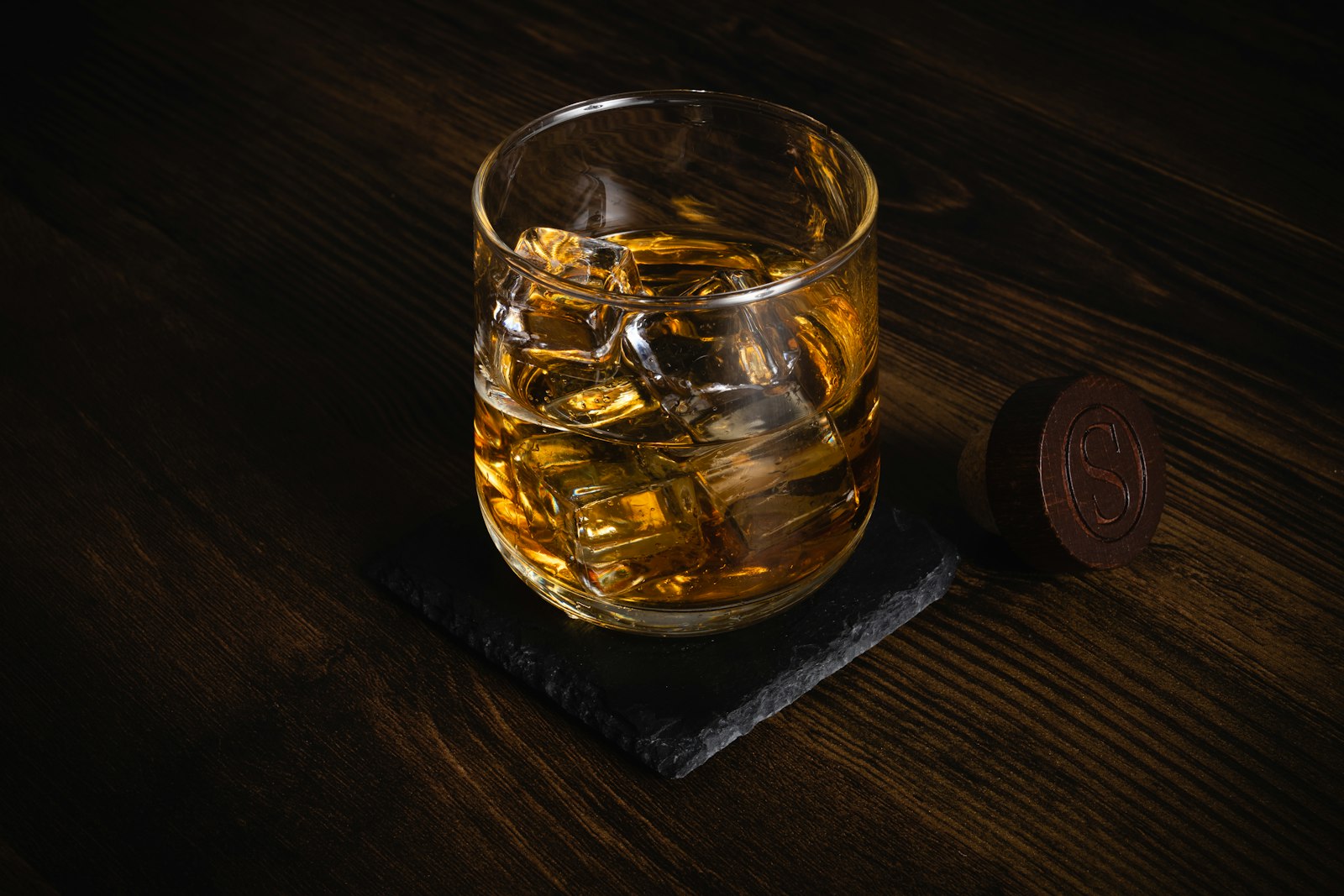
A mizuwari (水割り, literally “cut with water”) is Japanese whisky stirred over ice and lengthened with cold, soft water, usually at one part whisky to two or two-and-a-half parts water. That is the whole recipe. What English-language guides tend to skip is why Japan settled on this serve as its everyday way to drink whisky, why the order of the steps matters more than any stir count, and how to get a comparable result outside Japan, where the water coming out of the tap is often a very different liquid from the water Japanese recipes assume.
This guide covers the method as Suntory (サントリー) itself publishes it in Japanese, the history that made mizuwari a dinner-table drink rather than a bar trick, and the practical adjustments for readers in the US, UK, and Europe.
The method, step by step
Suntory’s official Japanese-language page on mizuwari lists six steps. They are worth reproducing closely, because the sequence is the point.
- Fill the glass to the top with ice and let it chill the glass.
- Pour in the whisky. A standard single measure is 30ml (about 1 oz).
- Stir thoroughly with a bar spoon or muddler, so the whisky itself is chilled before any water goes in.
- Top up the ice that has melted down, then add water at roughly 1 part whisky to 2 to 2.5 parts water.
- Stir lightly to combine.
- Serve.
Two details separate this from simply pouring whisky and water over ice. First, the whisky is chilled on its own before dilution. Cold whisky meeting cold water mixes evenly and the ice melts more slowly afterward, so the drink holds its strength for longer. Second, the ice is replenished after that first stir. The initial stir melts some ice, the glass is topped up to full again, and only then does the water go in. A full glass of ice stays colder and melts more slowly than a half-empty one.
English-language recipes frequently quote a precise number of stirs. Suntory’s own page does not give one. It says “stir thoroughly” (しっかりとまぜ) for the first stir and “stir lightly” (軽くまぜます) for the second. The reasoning is physical rather than ritual: chill the spirit hard, then combine gently so you are not melting the ice you just added. If you want a number to start from, count until the outside of the glass frosts on the first stir, and give it two or three turns on the second.
The ratio, and what it does to strength
Suntory describes 1:2 to 1:2.5 as “the basic ratio said to make a good mizuwari,” then adds that you should adjust it to taste. The arithmetic is useful here. A 40% ABV whisky cut 1:2 lands at roughly 13% ABV before ice melt, about the strength of a full-bodied wine. At 1:2.5 it drops to around 11%. As the ice melts during drinking, it goes lower still. That is the design intent: a whisky drink at table-wine strength that can sit alongside a meal for an hour.
Ice: big, hard, and from a bag
Suntory’s Japanese guidance and most Japanese bar manuals recommend large, store-bought cracked ice (かち割り氷) over freezer-tray cubes. Commercial ice is frozen slowly, which makes it clearer and denser, so it melts more slowly and dilutes the drink at a more predictable rate. Freezer cubes are cloudy because they trap air, and they break down fast. If bagged ice is not practical, make larger blocks in a silicone mould and crack them, or simply use the biggest cubes you have and accept that the drink will thin out faster.
Why Japan drinks whisky this way
Mizuwari is not an accident of taste. It was built, deliberately, by the Japanese whisky industry over several decades, and the reasons explain a lot about how Japanese blends are still constructed.
Whisky at the sushi counter
Suntory’s own centennial history records a 1970 campaign it called the Nihon-bashi strategy (二本箸作戦, “two chopsticks strategy”). The goal was to put Suntory whisky into restaurants where food is eaten with chopsticks: sushi bars, tempura counters, kappo (割烹) restaurants, even soba shops. These were places where sake had always been the drink. The company describes the aim as spreading “a new food culture of whisky with Japanese cuisine.” The name is a pun: Suntory’s Tokyo office was then in Nihonbashi (日本橋), and “nihon-bashi” can also be read as “two chopsticks.”
Whisky at 40% does not sit naturally next to raw fish. Whisky at 12% does. Mizuwari is the serve that made the strategy work, because it brings the spirit down to the strength of the sake it was competing with, and the cold water mutes the alcohol enough that delicate food is not overwhelmed. Business Insider Japan’s centennial feature on Suntory reports that sales of Suntory Old reached 5 million cases in 1974, 10 million in 1978, and 12.4 million in 1980. Suntory’s history page confirms the 12.4 million figure for 1980.
The bottle-keep era
The other half of the story is the bottle keep (ボトルキープ). From Japan’s high-growth decades onward, regulars at snack bars and izakaya bought a whole bottle, had their name written on it, and left it behind the counter for their next visit. JAL’s in-flight magazine site, in its Japanese guide to whisky serves, ties the mizuwari boom directly to this custom. A shared bottle on the table, an ice bucket and a jug of water, and a long evening of conversation: the drink had to be light enough to last, and the house made it to the same standard every time.
That standard did not happen by itself. In the same Business Insider Japan feature, Masaki Morimoto (森本昌紀), then a Suntory managing director and head of its spirits company, recalled that Suntory staff once “travelled the whole country working hard to teach people how to make a good mizuwari.” He made the remark while explaining the 2008 highball revival, which applied exactly the same playbook to soda: make sure the drink in the customer’s glass is good even when a part-time server builds it.
For the full story of that later revival, see our guide to the Japanese whisky highball, which picked up where mizuwari left off once the long slump that began after 1983 had, by Suntory’s figures, cut whisky sales volume to a sixth of its peak by 2007.
Mizuwari versus twice-up, half-rock and highball
Japanese bars and drinks writers distinguish several water-based serves that English-language menus often lump together. They are not interchangeable, because temperature changes what you can smell and taste in a whisky as much as dilution does.
| Serve | Build | Temperature | Approx. ABV (40% whisky) |
|---|---|---|---|
| Mizuwari (水割り) | 1 whisky : 2 to 2.5 cold water, full glass of ice | Very cold | 11 to 13%, falling |
| Twice-up (トワイスアップ) | 1 : 1 room-temperature water, no ice | Room temperature | About 20% |
| Half-rock (ハーフロック) | 1 : 1 water over ice | Cold | About 20%, falling |
| Highball (ハイボール) | 1 : 3 to 4 chilled soda, ice | Very cold | 8 to 10% |
The twice-up is the one to understand. JAL’s guide notes that blenders typically evaluate whisky diluted to around 20% ABV, because that strength makes aroma easiest to read, and it stresses that the water should not be chilled, since cold suppresses some aromas. Kunimasa Koga (古賀邦正), an agricultural scientist writing for Kodansha’s Blue Backs science imprint, makes the same point: blenders assess whisky cut 1:1 with water. Twice-up is therefore a tasting serve. Mizuwari is a drinking serve. It trades aromatic detail for refreshment and length, on purpose.
Water is half the drink
At 1:2.5, more than two-thirds of the glass is water. That is why Japanese sources spend so much attention on it, and why recipes written in Japan do not always translate directly.
Soft water, not hard
Suntory’s recipe specifies natural mineral water (天然水). JAL’s guide is more pointed: the water used for mizuwari should be soft, with low hardness, because hard water brings out bitterness. Most Japanese bottled waters are soft, including Suntory’s own Minami Alps Tennensui (南アルプスの天然水), which is drawn from the same mountain range that supplies water to the company’s Hakushu distillery. In other words, a Japanese drinker following a Japanese recipe is almost automatically using soft water. A reader in London, much of the American Midwest, or southern Germany may be using some of the hardest tap water in their country.
What to use outside Japan
- Check the label. European bottled waters print their calcium and magnesium content. Lower combined figures mean softer water. Volvic is a widely sold soft option; Evian is noticeably harder.
- Filtered tap water is a reasonable compromise in hard-water areas. A jug filter reduces some hardness and removes chlorine, which matters more than people expect at this dilution.
- Avoid sparkling and heavily mineralised waters. They turn a mizuwari into something else.
- Chill the water in the fridge first. Room-temperature water melts the ice faster and thins the drink.
Which whiskies suit mizuwari
JAL’s guide recommends “well-balanced blends or single malts” for mizuwari. That is a polite way of saying the serve rewards whiskies built for it, and Japanese blends largely were.
Blends built for dilution
Japanese blended whisky came of age in exactly the era described above, when much of the volume was going into mizuwari and, later, highballs. Blenders working for that market had to make whisky that held its shape at a fraction of its bottled strength. Grain whisky gives structure and a clean base; malt carries aroma through the water. That is why a mid-priced blend often makes a better mizuwari than an expensive single malt. Our reviews of Suntory Toki and Hibiki Japanese Harmony cover two of the most widely exported examples, both blends bottled at 43%.
Stronger whiskies need more water
The 1:2 ratio assumes a whisky at around 40 to 43%. A bottle at a higher strength needs adjusting, or the drink ends up much stronger than intended.
| Whisky | Bottled ABV | Ratio for about 12 to 13% |
|---|---|---|
| Suntory Toki | 43% | 1 : 2.3 |
| Hibiki Japanese Harmony | 43% | 1 : 2.3 |
| Nikka From the Barrel | 51.4% | 1 : 3 |
| Cask strength single cask | 55 to 62% | 1 : 3.5 to 4 |
Nikka From the Barrel is an interesting case. It was designed to be bottled at high strength, and our Nikka From the Barrel review explains why. At 1:3 it lands in mizuwari territory while keeping more weight than a 40% blend would. For very high-strength bottles, see our guide to cask strength Japanese whisky before you decide whether diluting one this heavily is a good use of it. For very old, expensive malts, a twice-up shows far more of what you paid for.
What it means for the drinker
The reason to try a mizuwari is not novelty. It is that it shows you Japanese whisky the way much of it was designed to be drunk. Many of the blends that built the category were made for a glass of ice and water next to a plate of food, and they make more sense in that context than in a tasting glass. If you have found a Japanese blend “too light” neat, that lightness was often the design brief. Made properly, with chilled whisky, a full glass of hard ice and soft cold water, mizuwari is a drink you can put next to grilled fish, tempura or yakitori and keep drinking for an hour without the whisky taking over the meal.
If you are coming from Scotch, our explainer on how Japanese whisky differs from Scotch covers the production choices behind that lighter profile.
Where to buy whiskies for mizuwari
The whiskies above are the easiest Japanese bottles to find outside Japan.
- US: Suntory Toki and Hibiki Japanese Harmony are carried by large chains and many independent liquor stores; Nikka From the Barrel is more often found at specialist shops. State-by-state rules apply, which our guide to buying Japanese whisky in the US explains.
- UK: All three are stocked by major online whisky retailers and some supermarkets. See where to buy Japanese whisky in the UK.
- EU: Availability varies by country. Specialist online retailers in Germany, France and the Netherlands generally list Toki, Harmony and From the Barrel, though prices and stock move often.
FAQ
Q: What is the correct mizuwari ratio?
A: Suntory’s official Japanese guidance gives one part whisky to two to two-and-a-half parts water as the basic ratio, then tells drinkers to adjust to taste. For a 40% whisky that produces a drink of roughly 11 to 13% ABV before ice melt. Higher-strength whiskies need proportionally more water to land in the same range.
Q: Is mizuwari the same as whisky and water?
A: The ingredients are the same, but the method differs. Japanese mizuwari chills the whisky on ice first, tops the ice back up, and only then adds cold water and stirs lightly. That sequence keeps the drink colder and slows dilution, so it holds its strength through a meal instead of thinning out within minutes of being poured.
Q: How many times should you stir a mizuwari?
A: Suntory’s own Japanese page does not specify a number. It says to stir thoroughly after adding the whisky, then lightly after adding the water. A practical guide is to stir until the outside of the glass frosts the first time, then give two or three gentle turns after the water goes in, so you do not melt the fresh ice.
Q: What is the difference between mizuwari and twice-up?
A: Twice-up is whisky and room-temperature water at 1:1 with no ice, roughly 20% ABV, and it is close to how blenders evaluate whisky because aroma is easiest to read at that strength. Mizuwari is far more dilute and served very cold. It is meant for drinking alongside food, not for analysing a whisky.
Sources
- Suntory, “水割り ウイスキーのおいしい飲み方” (official mizuwari method and ratio) (Japanese) — https://www.suntory.co.jp/whisky/beginner/drink/water.html
- Suntory, “HISTORY | サントリーウイスキー100周年” (1970 Nihon-bashi strategy; Suntory Old shipments in 1980) (Japanese) — https://www.suntory.co.jp/whisky/100th/history/
- Suntory Customer Center, “初めてウイスキーを飲んでみようと思います。どのような飲み方がおすすめですか?” (Japanese) — https://www.suntory.co.jp/customer/faq/005510.html
- Business Insider Japan, Suntory whisky centennial feature with Masaki Morimoto (Japanese) — https://www.businessinsider.jp/article/265638/
- JAL SKYWARD+, “ウイスキーの飲み方” guide to whisky serves (Japanese) — https://skywardplus.jal.co.jp/plus_one/other/whisky_drink
- Kunimasa Koga, Gendai Business / Blue Backs, “「ウイスキー」を「水割り」で飲むのは正しくない?” (Japanese) — https://gendai.media/articles/-/107281