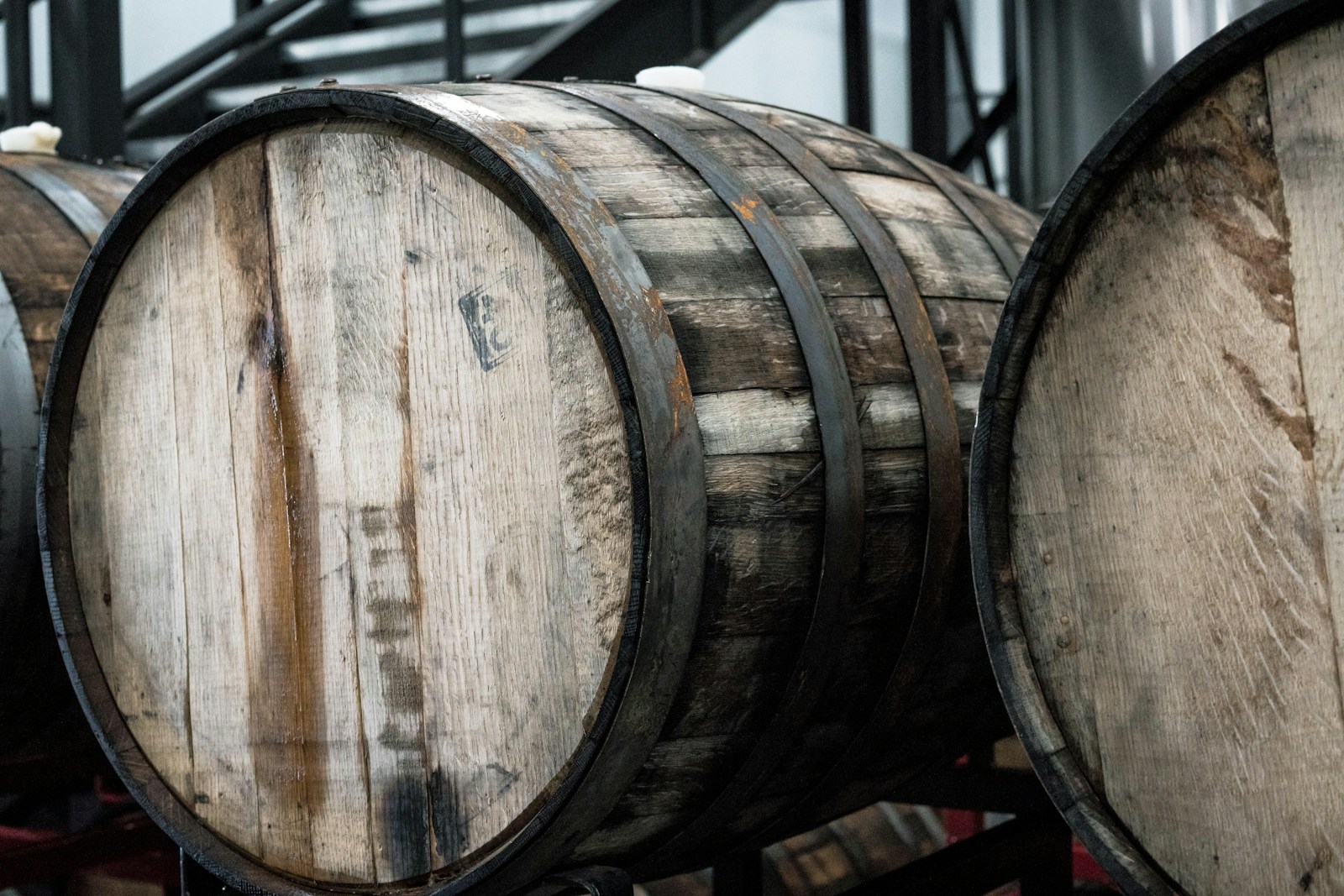
Mizunara (水楢) is a species of Japanese oak, Quercus crispula, and it shows up on more and more whisky labels every year — not only from Japan, but increasingly from Scotland and the United States too. The name itself is usually explained as “water oak,” a reference to how much moisture the living wood holds compared with the oaks coopers normally reach for. That single trait is the starting point for almost everything unusual about it: why it is difficult to turn into a cask, why casks made from it are rare, and why bottles that use it tend to cost more.
What mizunara actually is, and how it ended up in whisky
Mizunara grows across Hokkaido and the cooler, higher-altitude parts of Japan’s main islands, in the same general climate as some of the country’s whisky-producing regions. It was not the original choice for whisky casks: Japan’s early distillers, like Scotland’s, built their business on imported American and European oak. Mizunara casks are generally described as a wartime and postwar improvisation — when imported cask timber became difficult to source, Japanese producers turned to a domestic oak instead, mostly out of necessity rather than because anyone had identified something special in the wood.
By most accounts, those early mizunara casks were not celebrated at the time; they were simply what was available. The wood’s now-famous aroma only became apparent gradually, because the whisky aged in it long enough for the wood’s character to actually develop, and it took decades of hindsight for producers to recognize that the accidental substitute had produced something distinctive rather than merely adequate. That accidental origin is worth keeping in mind whenever mizunara is marketed as though it were chosen from the start for its flavor: the wood was a wartime substitute that turned out, much later and mostly by luck, to be interesting in its own right.
Why mizunara is so hard to turn into a cask
What makes mizunara difficult is not really the tree, it is the plank. Oak barrels stay watertight largely because of tylose, a natural structure that plugs the wood’s internal vessels once a tree is felled. According to an account from a working cooper published by the Japanese trade title WHISKY Magazine Japan (Japanese), mizunara simply contains less tylose than American oak, which is the main reason mizunara casks leak more readily if they are not built with unusual care.
Selecting the wood, board by board
Coopers compensate by hand-selecting individual logs, checking grain direction and the position of knots before a board is ever cut, because a plank with crooked or interrupted grain is far more likely to weep. Suntory’s own account of its mizunara program describes seeking out oak with “perfectly straight grain to ensure the casks are watertight,” which is a stricter standard than most oak species require.
Bending wood that does not want to bend
Mizunara is also less pliable than American or European oak, so shaping staves into the curved form of a cask takes more than the usual steam-and-clamp process. The cooper interviewed by WHISKY Magazine Japan described heating the boards, then leaving them to rest for weeks so the bent shape “sets” before assembly — and even after that, wooden pegs are sometimes driven into a finished cask to plug a seam that still leaks, or a stave is swapped out entirely if it cannot be sealed. None of this is exotic technique for its own sake; it is what it actually takes to make a leak-resistant vessel out of a wood that was not naturally suited to the job.
A long wait before the wood can even be used
Freshly cut mizunara also has to season for an extended period before cooperage, since working it too soon, or drying it too fast, causes cracking. That seasoning time, on top of hand-selection and slow bending, is a large part of why mizunara casks take longer and cost more to produce than casks from more forgiving oak.
Where the aroma people talk about actually comes from
Mizunara-aged whisky is consistently described with the same handful of words: coconut, sandalwood, and something like temple incense. Rather than rely on tasting notes we cannot verify ourselves, it’s worth citing where that description actually comes from. In 2008, Suntory published research conducted with the International Centre for Brewing and Distilling and the Scotch Whisky Research Institute, reported at the time by the Japanese trade paper Nissyoku Shimbun (Japanese), which traced the coconut-like note in mizunara-matured whisky to the balance between the cis and trans forms of whiskey lactone, a compound that dissolves out of the wood during maturation. That is a real, published finding about one specific aroma note; the more poetic “temple incense” and “sandalwood” descriptions that circulate around mizunara are widely repeated by drinks writers and by Suntory’s own marketing material, but we could not find a peer-reviewed source isolating the exact compounds behind those particular notes, so we’re presenting them here as commonly used descriptors rather than settled science.
What does appear to be well established is the timeline: producers and independent write-ups generally agree that mizunara’s character takes far longer to show up than a typical American or European oak cask, with the wood’s contribution described as underwhelming or overly resinous when young, and only becoming distinctive after considerably longer maturation. For that reason, mizunara is used more often as a finishing cask, added late in a whisky’s life, than as the primary maturation vessel from day one.
That slow timeline also explains why mizunara is used two different ways in practice. Some producers fill mizunara casks from the start and simply wait out the long development period, accepting that the whisky will spend its early years tasting more like raw wood than finished spirit. Others age a whisky mainly in American or European oak, where the flavor develops on a more predictable schedule, and then transfer it into mizunara for a final stretch of months or a few years, borrowing the distinctive top notes without gambling an entire multi-decade maturation on a wood that behaves less consistently than American oak does. Most of the mizunara-finished bottles reaching international markets today, including releases from outside Japan, use this second approach.
Why all of this shows up in the price
Every step above adds cost, and the tree itself compounds the problem. Mizunara is commonly cited as needing roughly 200 years, sometimes more, to reach the size and quality needed for cooperage — several times longer than the 70-to-120-year range typically cited for American white oak. Suntory has stated that mizunara casks make up under 1 percent of its total cask inventory. Combine a centuries-long growing cycle, labor-intensive hand-selection, slow bending, extended seasoning and a meaningfully higher failure/repair rate, and it is not surprising that whisky finished or matured in mizunara consistently sits at the upper end of a distillery’s range. We go into the broader mechanics of Japanese whisky pricing, including how scarce cask stock in general pushes prices up, in our companion article on why Japanese whisky is so expensive; mizunara is really a concentrated example of the same pattern.
Mizunara next to the oaks it’s usually compared with
| Oak type | Leak resistance | Typical time to maturity | Commonly cited aroma notes |
|---|---|---|---|
| Mizunara (Japanese oak) | Lower tylose content; leak-prone unless hand-selected | Often cited around 200+ years | Coconut, sandalwood and incense-like notes, mainly after long maturation |
| American white oak | High tylose content; naturally watertight | Commonly cited around 70-120 years | Vanilla, coconut, caramel |
| European oak (French/Spanish) | Tighter grain; generally reliable | Commonly cited around 150-200+ years | Dried fruit, spice, tannin |
Not just a Japanese story anymore
Mizunara is often framed as one of the clearest points of difference between Japanese whisky and Scotch, but that line has blurred. In 2015, Beam Suntory’s Islay distillery Bowmore released a Mizunara Cask Finish, a limited run of 2,000 bottles and, by most accounts, the first Scotch single malt finished in Japanese oak — made possible because Suntory’s ownership of Bowmore gave the distillery access to a mizunara supply chain that most Scottish producers simply do not have. In the years since, American producers have joined in from the other direction: Kentucky-based Barrell Craft Spirits and Louisville’s Rabbit Hole Distillery have both released bourbons finished in mizunara casks, aiming for the same coconut-and-spice character that shows up in Japanese examples. None of this makes mizunara any easier to work with — the wood is the same difficult material wherever it ends up — but it does mean the “hard to find, harder to work” cask type is no longer something only Japanese distillers are willing to deal with.
Inside Japan, the current generation of craft distillers has leaned into mizunara rather than away from it. Chichibu in particular built part of its reputation on mizunara casks sourced and coopered domestically, and forest-adjacent producers such as Hakushu, which sits inside land Suntory itself manages for water and timber stewardship, have an unusually direct relationship with where the wood actually comes from.
Q: Is mizunara oak actually rare, or is that just marketing?
A: It is genuinely scarce, for reasons that are mostly biological rather than manufactured. Trees are commonly cited as needing roughly 200 years to reach a usable size, Japan’s supply is limited to specific cooler regions, and a meaningful share of harvested logs are rejected at the grain-selection stage before they ever become barrel staves. Suntory has stated that mizunara casks account for under 1 percent of its total cask inventory, which is a fair indication of how thin the supply really is relative to demand.
Q: Why do mizunara casks leak more than other oak barrels?
A: Coopers who work with the wood attribute it to mizunara containing less of a natural sealing structure called tylose than American white oak has, which is the main reason barrels made from ordinary mizunara boards are prone to weeping. Producers compensate with strict grain selection, careful cooperage, and occasional hands-on repairs such as driving a wooden peg into a leaking seam.
Q: Does mizunara make a whisky taste better than one aged in American or European oak?
A: That’s a matter of preference rather than a fact this guide can settle, since we have not tasted these whiskies ourselves and won’t render a verdict on flavor. What can be said is that mizunara produces a different, more incense-and-sandalwood-leaning profile than the vanilla-forward character typical of American oak, and it generally needs longer maturation to show that character clearly, which is why it is more often used to finish a whisky than to age it from the start.
Q: Can non-Japanese distilleries legally use mizunara casks?
A: Yes. Mizunara is a wood, not a protected designation, so any distillery that can source the casks is free to use them, and several already have, including Scotland’s Bowmore and American producers such as Barrell Craft Spirits and Rabbit Hole Distillery. The limiting factor is supply and cost, not law, since mizunara casks are scarce and expensive wherever a distillery is based.
Sources:
- WHISKY Magazine Japan, cooper’s account of mizunara cask-making, “The truth about mizunara casks” (Japanese) — whiskymag.jp
- Nissyoku Shimbun, report on Suntory’s joint research into mizunara aroma compounds, October 2008 (Japanese) — news.nissyoku.co.jp
- Suntory House, official mizunara oak story — house.suntory.com
- just-drinks, product launch report on Bowmore Mizunara Cask Finish, 2015 — just-drinks.com