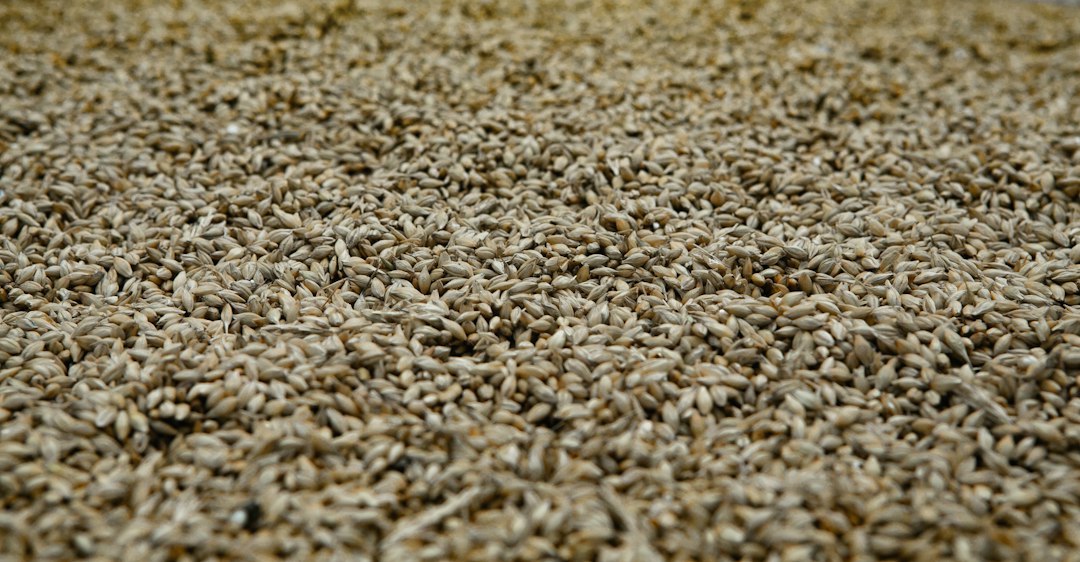
Peated Japanese whisky is malt whisky made from barley that was dried over burning peat, which leaves smoky phenolic compounds on the grain. Japan has no Islay. Most of its distilleries make little or no heavily peated spirit, and where producers name their peat source, it is usually Scotland. A small group of producers now treat smoke as their main style. One of them, in eastern Hokkaido, digs its own peat from a local wetland.
This guide covers who uses peat in Japan, where it comes from, and how to tell from a Japanese label whether a bottle is smoky. It draws on the producers’ own Japanese-language statements and local reporting.
What “peated” means, and why Japan mostly moved away from it
Peat is partly decomposed plant matter that builds up in waterlogged ground over thousands of years. Maltsters burn it in the kiln while drying barley, and the smoke leaves compounds on the grain that survive into the spirit. Peat is not added to the spirit, the water or the cask.
Suntory’s own framing: smoke is where whisky started
Suntory (サントリー), which owns the Islay distilleries Laphroaig and Bowmore as well as Yamazaki and Hakushu, describes smoke on its Japanese-language smoky malts page as the “source” of whisky. The page makes a historical point that is easy to forget. At one time, it says, all malt whisky was made from peated malt. In recent decades, malts made from lightly peated or completely unpeated barley have become the mainstream. Suntory presents its peated Scotch brands as keepers of that older style.
Japan’s industry grew up during that shift, and its big producers built their reputations on blends such as Hibiki and malts like Yamazaki, where smoke plays a supporting role. For a broader look at how those choices separate Japanese whisky from Scotch, see our guide to Japanese whisky vs Scotch.
Peat as a blending component, not a house style
At most large Japanese distilleries, peated spirit is one ingredient among many. Suntory’s Hakushu (白州) distillery says that its single malt uses peated malt for only part of its production. Visitors on the distillery tour are shown four raw materials side by side, two-row barley, malt, peat and peated malt, and are invited to compare the smell of peated malt with malt dried without peat. Hakushu also uses pot stills of different sizes and shapes so it can make a range of spirit styles under one roof. Smoke is one option on a menu, not the default.
The smoke is usually there, but blended down. Our Hakushu 12 review looks at how one widely available bottle uses it.
Where Japan’s peat actually comes from
This is the question top-ranking English guides rarely answer. Japan has peatlands, especially in Hokkaido, but where Japanese producers disclose the origin of their peat, it is usually Scottish. A distillery that buys malt already kilned is also, in effect, buying the maltster’s choice of peat, which is why so few labels say where the smoke came from.
Scotland’s peatlands and Suntory’s restoration project
Suntory, the largest Japanese whisky maker, has tied its own peat use to Scotland’s peatlands and now pays to restore them. In 2021 Suntory Holdings and Suntory Global Spirits launched the Peatland Water Sanctuary project. According to the company’s Japanese sustainability report, it plans to invest more than US$4 million by 2030. The target is to restore and protect at least 1,300 hectares of peatland by 2030, an area able to regenerate as much peat as the group uses in whisky making. By 2040 it aims to double that figure.
The same report notes that peatland covers about a quarter of Scotland and that an estimated 70 to 90 percent of it has been damaged by extraction for horticulture, agriculture and commercial use. Peat forms slowly, so the industry’s reliance on it is now an environmental question as well as a flavor one.
Saburomaru: choosing between Highland and Islay peat
Saburomaru (三郎丸) distillery in Toyama Prefecture shows how much the peat source can matter even when it is imported. The distillery’s parent, the sake brewer Wakatsuru Shuzo (若鶴酒造), has made smoky whisky since it began distilling in 1952. In 2020 it ran two separate batches. One used malt smoked with peat from the inland Scottish Highlands, the other with peat from Islay. Everything else was held constant.
The company’s own release describes the difference. Highland peat, it says, gives a more direct, forceful smokiness with a dry character like burning dried wood. Islay peat, used in the earlier Saburomaru III The Empress, is described as carrying a sea-like saltiness and softness. The Highland batch became Saburomaru IV The Emperor, released in June 2024 and labeled as made from “heavily Highland peated 50PPM” malt. That kind of controlled comparison is rare anywhere. Our Saburomaru distillery guide covers the distillery’s history in detail.
Akkeshi: digging peat from a Hokkaido wetland
Akkeshi (厚岸) distillery, on the east coast of Hokkaido, is the clearest exception to the import rule. According to the Hokkaido Shimbun (北海道新聞), the distillery’s operator Kenten Jitsugyo (堅展実業) carried out a test dig in a wetland inside the town on November 1, 2019. It had surveyed several sites the previous year and judged privately owned land in the coastal Monshizu (門静) district best for both volume and quality. Using peat samplers at nine points across about 20,000 square meters, it found peat one to two meters thick, starting 20 to 40 centimeters below the surface.
The plan reported at the time was to dig five tonnes in 2020 and use it in production from 2021. Later product descriptions refer to Hokkaido-grown malt smoked with “Akkeshi peat.” We could not confirm how much of Akkeshi’s current output uses local peat versus imported peated malt, so treat it as one ingredient in the range, not the whole. Our Akkeshi distillery guide explains why the founder picked a town that reminded him of Islay.
The Japanese distilleries that use peat, and how
The table below summarizes what the producers themselves have said about peat. It only includes approaches that are stated in published sources. Where a producer has not disclosed peating levels or peat origin, the table says so instead of guessing.
| Distillery | How peat is used (published) | Peat source stated | Example bottling |
|---|---|---|---|
| Saburomaru | Smoky whisky since 1952; heavily peated is the house style | Scottish Highland and Islay peat | Saburomaru IV The Emperor |
| Akkeshi | Peated malt central to the style | Local Akkeshi peat in part; test dig in 2019 | Akkeshi seasonal releases |
| Yoichi | Peat-dried barley historically; robust, smoky spirit | Town historically rich in peat; current source not stated | Single Malt Yoichi |
| Hakushu | Peated malt used for part of production | Not stated | Hakushu 12 |
| Mars Komagatake | Peated malt in limited releases | Not stated | Komagatake Peated x Sherry |
Yoichi: why Masataka Taketsuru chose a peat town
Nikka (ニッカ) founder Masataka Taketsuru (竹鶴政孝) studied in Scotland before choosing Yoichi (余市), on Hokkaido’s Sea of Japan coast, for his first distillery. In an interview for the Japanese government’s Highlighting Japan magazine, Shuichi Kiriyama of Asahi Breweries, which markets Nikka, explained that Yoichi offered a cool, humid climate like Scotland’s, ample water, clean air, and abundant peat for giving whisky its smoky aroma. The distillery’s kiln tower, where barley was dried and smoked over peat, still stands on the site.
Yoichi has also kept coal-fired direct heating of its stills since its founding, a method Kiriyama described as inefficient but essential to the spirit’s heavy, powerful character. The same article notes that the smoke from peat used in drying comes through relatively strongly in Yoichi. For background on the site itself, see our Yoichi distillery guide.
Nikka’s experiment: a peated Miyagikyo and an unpeated Yoichi
Nikka has used peat to show what each of its two malt distilleries contributes. In September 2021 it released Single Malt Yoichi Non-Peated and Single Malt Miyagikyo Peated as the first edition of its Nikka Discovery series, each limited to 10,000 bottles at ¥22,000. Japanese trade coverage said the theme was “the individuality that comes from differences in raw materials.” The point was to strip Yoichi of the smoke it is known for, and to add smoke to Miyagikyo (宮城峡), which is known for a softer, fruitier style. Both bottlings work as a lesson in how much of a distillery’s reputation comes from peat and how much from everything else. Our Miyagikyo distillery guide explains that softer house style.
Mars Komagatake and the new wave
Hombo Shuzo’s (本坊酒造) Mars Komagatake distillery in Nagano has used peated malt in limited editions. Its latest, Komagatake Peated x Sherry, pairs peated spirit with sherry cask maturation and was announced in September 2026 at ¥9,900. Hombo did not disclose the peating level. We covered the release in our Komagatake Peated x Sherry news report.
How to tell if a Japanese whisky is peated from the label
The second question English-language guides leave unanswered is practical. Japanese labels rarely give a peat level, and the words used are not standardized. Here is what to look for.
Words to look for, in English and Japanese
- Peated / ピーテッド: the most common marker. On Japanese back labels it may appear in katakana.
- Heavily peated / ヘビーピート: used by producers such as Saburomaru for their smokiest batches.
- Non-peated / ノンピーテッド: as in Nikka’s 2021 Yoichi release. Its presence usually means the distillery’s normal output is smoky.
- Smoky / スモーキー: a flavor description, not a production term. It may refer to peat, to cask char, or to both.
- A ppm figure: shown only by some producers, such as the “50PPM” on Saburomaru IV.
The absence of any of these words does not mean a whisky is unpeated. Many Japanese single malts and blends contain some peated spirit without saying so, as Hakushu’s partial use shows. Reading the producer’s own description is more useful than reading the front label.
Why a ppm number does not tell you how smoky the glass is
When a producer gives a ppm figure, it refers to phenol content measured in the malted barley, not in the finished whisky. A large share of those compounds is lost during distillation, and more change during years in the cask. The type of cask matters too. A peated spirit aged in sherry casks, such as the new Komagatake release, will present differently from the same spirit in a refill bourbon barrel. Our guide to Japanese whisky cask types explains how wood shapes the final spirit.
Where to buy peated Japanese whisky
Availability depends heavily on the producer. The large distilleries export widely. The craft producers sell most of their limited releases in Japan first, and often by lottery.
United States
Hakushu 12 and Single Malt Yoichi are the peated-leaning bottles most likely to appear on US shelves, through Suntory’s and Nikka’s import channels. Akkeshi and Saburomaru appear occasionally through specialist importers, usually in small allocations. Our guide to where to buy Japanese whisky in the US lists the retailer types worth checking.
United Kingdom and Europe
UK specialist retailers tend to carry a wider range of Japanese craft whisky than US stores, including occasional Saburomaru and Akkeshi releases. Saburomaru IV was announced for both domestic and overseas sale. In the EU, availability is uneven and depends on each importer’s allocations. See our guide to where to buy Japanese whisky in the UK for practical steps.
What peat means for the drinker
Peated Japanese whisky is not a copy of Islay. The large producers use smoke as one ingredient in a blend, which keeps it in the background. The specialists have made deliberate and very different bets. Saburomaru built its identity on heavily peated whisky and then tested whether Highland and Islay peat produce different spirits. Akkeshi went further and began digging peat from the wetland outside its own door.
For a drinker, the producer’s reasoning is the best guide to the bottle. Choose Saburomaru to explore how peat origin changes a spirit. Choose Akkeshi to taste an attempt at local terroir, from local barley to local peat. Choose Yoichi or Hakushu to see how Japan’s original malt distilleries use smoke within a balanced style. If you are new to the category, start with our explainer on what counts as Japanese whisky, since labeling rules affect which smoky bottles are truly made in Japan.
FAQ
Q: Is Japanese whisky usually peated?
A: Most Japanese whisky contains little or no prominent peat. Large producers such as Suntory use peated malt for only part of their production and blend it with unpeated spirit. A few distilleries, including Saburomaru and Akkeshi, make heavily peated whisky their main style, so smokiness varies widely by producer.
Q: Does Japan use its own peat for whisky?
A: Where Japanese producers disclose their peat source, it is usually Scotland, and Suntory funds peatland restoration there. Akkeshi distillery in Hokkaido is the notable exception. It test-dug peat from a local wetland in 2019 and has since described some releases as using Hokkaido malt smoked with Akkeshi peat.
Q: What is the smokiest Japanese whisky?
A: Saburomaru is generally regarded as Japan’s most committed producer of heavily peated whisky, and its Saburomaru IV is labeled as made from 50ppm Highland-peated malt. Remember that ppm is measured in the malt, not the bottle, so cask type and age also shape how smoky the final whisky seems.
Q: How can I tell if a Japanese whisky is peated?
A: Look for “peated,” “heavily peated” or the katakana ピーテッド on the label, or a ppm figure. A “non-peated” label usually signals that the distillery’s normal output is smoky. Many bottles contain some peated spirit without saying so, so check the producer’s own product description as well.
Sources
- Suntory, “Smoky Malts” (Japanese) — https://www.suntory.co.jp/whisky/smokymalts/
- Suntory, “Peatland Water Sanctuary project” sustainability story (Japanese) — https://www.suntory.co.jp/sustainability/story/015/
- Suntory Whisky Distillery Blog, “Introducing the Hakushu distillery tour” (Japanese) — https://www.suntory.co.jp/factory/blog-d/000093.html
- Wakatsuru Shuzo, Saburomaru IV The Emperor press release via Kyodo News PR Wire (Japanese) — https://kyodonewsprwire.jp/release/202406212524
- Hokkaido Shimbun, “Akkeshi distillery test-digs peat for whisky” (Japanese) — https://www.hokkaido-np.co.jp/movies/detail/6099692053001/
- Highlighting Japan (Government of Japan), “Rich, powerful whisky nurtured in Hokkaido,” October 2020 (Japanese) — https://www.gov-online.go.jp/eng/publicity/book/hlj/html/202010/202010_12_jp.html
- Gourmet Watch (Impress), Nikka Single Malt Yoichi Non-Peated and Miyagikyo Peated release (Japanese) — https://gourmet.watch.impress.co.jp/docs/news/1353424.html