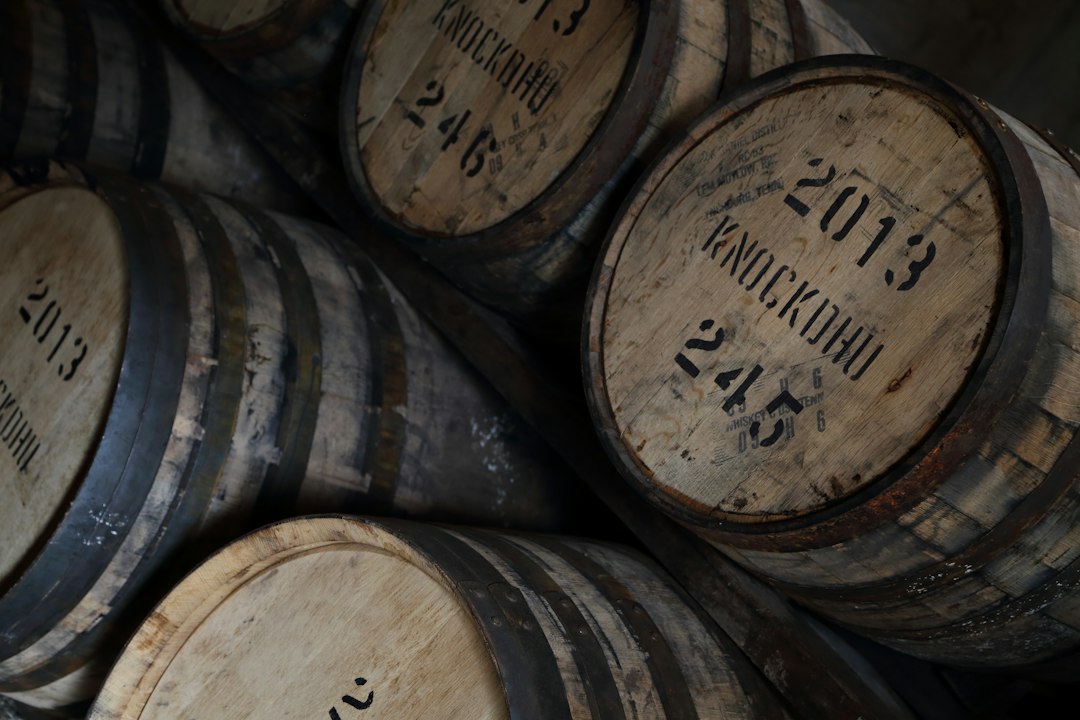
Japan’s climate does change how whisky matures, but not in one direction. A basin distillery with hot summers and freezing winters pushes spirit into the wood harder and loses more to evaporation. A cool, foggy coastal or mountain site slows the same process down. Japanese distillers know this, and the more interesting ones now treat climate as an ingredient they choose rather than a condition they put up with.
This guide reads what producers say, mostly in Japanese, about their warehouses. It also answers two questions the usual articles skip: whether a Japanese 12-year-old is really “older” than a Scotch, and why some companies now ship new spirit elsewhere just to age it.
What climate actually does inside a cask
A filled cask is not sealed. Oak lets a small amount of liquid and vapor pass through, and the air space above the spirit expands and contracts with temperature. Japanese producers describe this as the cask “breathing,” and the description is close to how the physics works.
Temperature swings move spirit in and out of the wood
When a warehouse warms up, the spirit and the air in the cask expand, pressure rises, and spirit is pushed deeper into the staves. When it cools, the liquid contracts and draws back out, carrying extracted wood compounds with it. Nikkan Kogyo Shimbun (日刊工業新聞), describing the warehouse at Chichibu (秩父), put it simply: in summer the air inside the cask is pushed out, in winter air is drawn back in, and that repeated breathing deepens maturation.
The size of the swing matters more than the average temperature. A site that is mild all year can be warmer on average than a basin town and still cycle the cask less. That is why “Japan is hotter than Scotland” is too crude to explain anything on its own.
Humidity decides what evaporates first
Water and alcohol do not leave the cask at the same rate. In a damp warehouse, less water evaporates, so alcohol escapes proportionally faster and the strength in the cask drifts down over time. In a dry warehouse the opposite tends to happen. Chichibu’s earth-floored warehouse is a deliberate choice for this reason: the same Nikkan Kogyo report says the bare soil keeps humidity up even in the dry season, so alcohol evaporates ahead of water and the cask strength falls.
That is why sea fog, river mist and forest air recur in Japanese distillery descriptions. They are not decoration; they mean the warehouse stays humid.
The angel’s share is the visible cost
Every year some whisky simply disappears from the cask. At Mars Tsunuki (マルス津貫) in Kagoshima, the owner Hombo Shuzo (本坊酒造) states on its own site that 5 to 7 percent of the whisky in each cask evaporates every year. That figure covers one warehouse, not Japan as a whole, but at that rate a decade-old cask has lost a large share of its contents, part of why long-aged Japanese whisky costs what it does. We cover the rest of that equation in why Japanese whisky is so expensive.
Three climates, three philosophies
Read the founders’ own explanations and a pattern appears. Each chose a site because of how it would mature whisky, and each made a different bet.
Yoichi and Miyagikyo: chasing a Scottish pace
When Masataka Taketsuru (竹鶴政孝) founded Yoichi (余市) in 1934, he was not looking for speed. Nikka’s Japanese-language page says he needed “a climate like Scotland’s,” clean air and good water to reproduce what he had learned without compromise. The company describes Yoichi’s cold climate across all four seasons as one that matures whisky slowly, with sea wind and river fog supplying the humid air that cask storage needs.
Nikka even adds a careful line: Yoichi malt is “said to smell of the sea,” and the sea breeze from Ishikari Bay may be absorbed by the casks. The word “may” is Nikka’s own. A brand hedging its most romantic claim is worth noticing.
Miyagikyo (宮城峡), opened in 1969, follows the same logic in a different setting. Nikka says fog and mist hang over the valley throughout the year, the humid forest air protects the casks from drying out, and the spirit matures gently in a cool climate. Our Yoichi distillery guide covers how coal-fired stills fit into the same picture.
Chichibu: using the basin to go faster
Ichiro Akuto (肥土伊知郎) took the opposite approach. His family’s sake brewery had made whisky at Hanyu (羽生), and when that business was sold, around 400 casks faced disposal. He set up Venture Whisky in 2004 to save them, and opened Chichibu in 2008.
A 2021 Cabinet Office profile in Japanese lists two reasons he built in his hometown. One is the water. The other is the temperature range: winter mornings and evenings drop to minus 5 to minus 10°C, while summer passes 30°C, and that swing “advances maturation faster.” Nikkan Kogyo adds that Chichibu tastes every cask at least once a year to track how it is developing, which is what you would expect from a site where wood works quickly and an extra year can overshoot.
Akuto’s own words explain why he cared about speed at all. “Whisky is the act of bringing what our predecessors created into the future,” he told Nikkan Kogyo. “I felt we had to keep making it.” For a small distillery with no aged stock of its own, a climate that delivers mature whisky sooner was a way to survive, not a shortcut. Nor does it try to recreate Hanyu: with a different environment and different makers, the aim is whisky only Chichibu could make. More in our Chichibu distillery guide and the Hanyu story.
Akkeshi: chasing Islay, then splitting the climate
Keiichi Hida (樋田恵一) started Akkeshi (厚岸) because he loved Islay whisky. In an interview with Hokkaido Shimbun (北海道新聞), he said he toured eastern Hokkaido about 15 years ago looking for an environment like Islay’s. JAL’s travel magazine describes what he found: a cool, humid town covered by sea fog. The distillery started in 2016.
The interesting part is what came next. Rather than simply expand at Akkeshi, Hida chose to build a second distillery in Naka-Furano (中富良野), inland and among mountains. His reasoning, in his words: “Even with the same new make, if the climate is different, the flavors and aromas change during maturation.” He expects Akkeshi to remain the salty “sea whisky” and Naka-Furano to become a floral “mountain whisky.” Hokkaido Shimbun has also reported on whisky the company matured for more than three years in Furano. Hida added one practical detail: in the warehouse, Akkeshi moves casks between positions frequently, which he called typical of Japanese manufacturing care. See our Akkeshi distillery guide for the full background.
Mars: one company, three maturation climates
No Japanese producer has made climate a more explicit part of its range than Hombo Shuzo’s Mars Whisky. It distills at two sites, one in the mountains of Nagano and one in southern Kagoshima, and ages some of that spirit at a third.
Komagatake at altitude
Mars Komagatake (マルス駒ヶ岳) sits at 798 meters in the Central Alps of Nagano. Hombo’s site describes the single malt maturing “slowly, in silence, in a deep-fog forest,” in a warehouse with a faint humidity you can feel. The message is the same as Nikka’s: cool and damp, with time doing the work.
Tsunuki in a southern basin
Tsunuki is the company’s birthplace in Minamisatsuma, Kagoshima, where it started making shochu more than a century ago. Hombo describes the town as a basin ringed by hills of 475 and 513 meters, with hot summers and winters that are “unusually harsh for southern Satsuma.” The company says plainly that this climate has a large effect on maturation.
Then comes a detail most English coverage misses: the spirit rests in a stone warehouse with little temperature change through the year. The distillery picked a site with strong seasonal swings, then built a warehouse that softens them. Climate sets the starting conditions; warehouse design decides how much of it reaches the cask. More in our Tsunuki distillery guide.
The Yakushima Aging Cellar
The third site is not a distillery. The Mars Yakushima Aging Cellar (マルス屋久島エージングセラー) sits within the company’s Yakushima Densho-gura (屋久島伝承蔵) shochu brewery on Yakushima (屋久島), an island with more than 40 peaks above 1,000 meters and, according to Hombo, the heaviest rainfall in Japan. New make from Komagatake and Tsunuki is shipped there to mature. The Japanese food trade paper Nihon Shokuryo Shimbun (日本食糧新聞) reported that the dedicated brand, MARS The Y.A., was built on exactly this process, and Hombo lists The Y.A. #05 as a 2026 release.
Hombo says whisky aged in Yakushima’s varied climate “creates new value.” It does not claim faster or better, only different, and that is the right way to read it. Our Mars Shinshu guide and Hombo Shuzo profile explain how the three sites fit together.
How the sites compare
The table below summarizes what each producer says about its own maturation environment. It reflects published statements, not measurements.
| Site | Setting | What the producer says | Implied pace |
|---|---|---|---|
| Yoichi | Coastal Hokkaido, Sea of Japan | Cold year-round; sea wind and river fog keep casks humid | Slow |
| Miyagikyo | Forest valley west of Sendai | Fog and mist all year; humid air stops casks drying | Gentle |
| Chichibu | Inland basin, Saitama | Winters to minus 10°C, summers above 30°C; earth-floored warehouse | Fast |
| Akkeshi | Coastal eastern Hokkaido | Cool, humid, sea fog; chosen to resemble Islay | Slow |
| Mars Komagatake | 798 m, Central Alps, Nagano | Deep-fog forest; slow, quiet maturation | Slow |
| Mars Tsunuki | Basin, southern Kagoshima | Hot summers, harsh winters; stone warehouse; 5-7% yearly evaporation | Fast, buffered |
| Yakushima Aging Cellar | Mountainous island, heavy rainfall | Varied climate creates “new value” | Not stated |
Does faster maturation make a Japanese 12-year-old “older”?
You will often read that a Japanese whisky ages so quickly that 12 years in Japan equals 15 or more in Scotland. None of the producers quoted above make that claim in their own Japanese materials, and there is no standard conversion. We would treat any such figure as marketing.
Speed is not the same as maturity
A hot, swinging climate speeds up wood extraction (color, tannin, vanilla) and evaporation. Slower changes, such as oxidation and the softening of raw new-make character, depend more on time. A young whisky from a fast site can look old and still be young, which is why Chichibu checks every cask annually.
What an age statement does and does not tell you
An age statement is a legal minimum: the youngest whisky in the bottle spent at least that long in wood. It says nothing about where. Under the Japan Spirits and Liqueurs Makers Association standard, Japanese whisky needs at least three years of maturation in Japan, and our guide to Japanese whisky age statements explains the rest. Compare a 12-year-old from Yoichi with one from a hot basin site and you are comparing two different processes, not two points on the same scale.
Use climate to understand style, not to inflate or discount an age. A young Chichibu is not a cheat, and an old Yoichi is not slow because it is inferior.
Why producers now move spirit to age it elsewhere
The Mars and Akkeshi examples point to a newer trend. Distilleries are treating the maturation site as a variable they can change independently of the stills.
One spirit, several results
Hida’s line about the same new make changing with climate is the whole argument. For a blender, a second climate works like a second set of casks: more components, same stills. For drinkers, it creates something real to compare.
Other forms of the same idea
Others go further: Togouchi ages in a tunnel, and Shimoda has shown undersea aging. No effects are published as data, but the logic is the same: where a cask sits is a choice.
What this means when you choose a bottle
Climate gives you a way to read a label beyond age and cask type. If a bottle names a maturation site that is different from the distillery, such as Yakushima, Furano or a tunnel, the producer is telling you that the warehouse is part of the recipe. That deserves the same attention you would give to a sherry or mizunara cask.
If you want wood-forward whisky at a young age, look at basin and southern sites. For slow maturation, the cool coastal and mountain sites are built for it. The most honest test is two bottles from one producer aged in two places, which Mars and Akkeshi now make possible. Pair this with our guide to Japanese whisky cask types.
FAQ
Q: Does Japanese whisky really mature faster than Scotch?
A: Some of it does. Sites with large seasonal temperature swings, such as Chichibu’s basin, push spirit into the wood more often and lose more to evaporation. But cool, humid sites like Yoichi and Miyagikyo are described by Nikka itself as maturing slowly, so there is no single Japanese speed.
Q: How much whisky evaporates from a cask in Japan each year?
A: Few producers publish figures. Hombo Shuzo states that 5 to 7 percent evaporates every year from the stone warehouse at Mars Tsunuki in Kagoshima. That applies to one warehouse only. Evaporation varies with temperature, humidity, cask size and position, so it differs between and within distilleries.
Q: Is a 12-year-old Japanese whisky equal to an older Scotch?
A: No. There is no recognized conversion between Japanese and Scottish ages. A warm climate speeds up wood extraction and evaporation, but other parts of maturation still depend on time. An age statement only tells you the minimum time in wood, not how intense that time was.
Q: Why do some Japanese whiskies mention a maturation site different from the distillery?
A: Because the producer moved the spirit to age somewhere else on purpose. Mars ships new make from Komagatake and Tsunuki to its Yakushima Aging Cellar, and Akkeshi has matured whisky in Furano. The aim is a different maturation result from the same distillation, which gives blenders and drinkers more variety.
Sources
- Nikka Whisky, “Hokkaido Yoichi Distillery” (Japanese) — https://www.nikka.com/distilleries/yoichi/
- Nikka Whisky, “Sendai Miyagikyo Distillery” (Japanese) — https://www.nikka.com/distilleries/miyagikyo/
- Hombo Shuzo, “Mars Komagatake Distillery” (Japanese) — https://www.hombo.co.jp/visiting/komagatake/
- Hombo Shuzo, “Mars Tsunuki Distillery” (Japanese) — https://www.hombo.co.jp/visiting/tsunuki/
- Hombo Shuzo, “Yakushima Densho-gura and Mars Yakushima Aging Cellar” (Japanese) — https://www.hombo.co.jp/visiting/yakushima/
- Nihon Shokuryo Shimbun, “Hombo Shuzo launches new malt brand matured on Yakushima” (Japanese) — https://news.nissyoku.co.jp/?p=856489
- Cabinet Office, Highlighting Japan, “World-class whisky born of Chichibu’s nature,” January 2021 (Japanese) — https://www.gov-online.go.jp/eng/publicity/book/hlj/html/202101/202101_12_jp.html
- Nikkan Kogyo Shimbun / Newswitch, “Ichiro’s Malt was ‘led’ to Chichibu,” October 18, 2019 (Japanese) — https://newswitch.jp/p/19656
- Hokkaido Shimbun, Doshin BIZ interview with Kenten Jitsugyo president Keiichi Hida (Japanese) — https://www.hokkaido-np.co.jp/article/1290548/
- Hokkaido Shimbun, “Matured in Furano: Akkeshi Whisky maker releases new whisky” (Japanese) — https://www.hokkaido-np.co.jp/article/1290444/
- JAL SKYWARD+, “Akkeshi Whisky, recognized worldwide” (Japanese) — https://skywardplus.jal.co.jp/?p=5515